
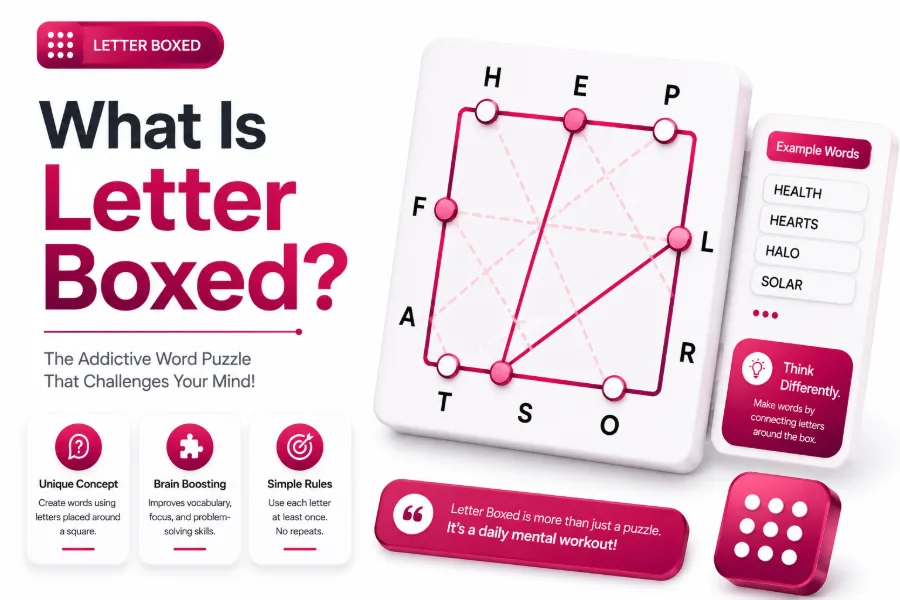
If you enjoy word games that require more than simply knowing a lot of words, you may have come across Letter Boxed. It is a word puzzle built around a square of letters, where players create connected words while following a simple but important set of rules. The goal is to use every letter on the board without selecting consecutive letters from the same side.
So, what is letter boxed? Letter Boxed is a word puzzle from The New York Times Games collection. Unlike a crossword, it does not give you clues or fixed spaces to fill. Instead, you work with letters placed around the four sides of a square and create a chain of words. The final letter of one word becomes the first letter of the next.
The puzzle looks easy when you first see it, but finding an efficient solution can require careful planning. Vocabulary helps, but recognizing letter patterns, difficult combinations, and useful word endings is just as important. Once you know the basic rules, you can start developing strategies that make even challenging boards easier to solve.
What Letter Boxed Is
Letter Boxed is a word puzzle in which letters are arranged around the four sides of a square. Players select those letters to create words, moving between different sides as they spell. The objective is to use every letter available on the board through a connected sequence of valid words.
The puzzle differs from many traditional word games because the position of each letter matters. You cannot simply arrange letters in any order to create words. The side of the square where each letter appears determines which letters you can select next, adding a strategic element to vocabulary-based play.
The Four-Sided Letter Board
The Letter Boxed board contains letters positioned along four sides: top, right, bottom, and left. Each side contains a group of letters that can be used to form words. You can move between the sides while spelling, but there is an important restriction on consecutive selections.
When you select one letter, your next letter must come from a different side. This means two letters located on the same side cannot be selected consecutively. The restriction applies even if those letters would normally appear next to each other in a valid word.
The Main Goal of Letter Boxed
The main objective is to use every letter on the board at least once. You accomplish this by creating a series of connected words. You do not need to use each letter only once, so repeating letters is allowed when it helps form a useful word or connect different parts of your solution.
The second important part is the word chain. When one word ends, the next word must begin with that same final letter. This forces you to think beyond individual words and consider how one word can lead naturally into another.
How the Word Chain Works
Imagine that you create a word ending in the letter R. Your next word must begin with R. If that second word ends in T, the following word needs to start with T. The process continues until all the letters on the board have been used.
This connection makes Letter Boxed different from a normal word search. Finding a valid word is only part of the task. You also need to consider where the word ends and whether its final letter gives you a useful starting point for the next word.
Important Letter Boxed facts:
- The board has four sides.
- Letters are arranged around the outside of the square.
- Consecutive letters must come from different sides.
- The final letter of one word starts the next word.
- Letters can be reused.
- Every board letter must be used.
- Planning is often more important than word length.
How the Letter Boxed Rules Work
Letter Boxed has only a few core rules, but they work together to create the puzzle’s challenge. You use the letters shown on the board to make valid words, while respecting their positions around the square. The words must also connect from one to another through their starting and ending letters.
Because of these restrictions, a word that looks perfectly suitable may not actually work. You need to check both the spelling and the position of each letter. This is why players often need to test several possible words before finding a chain that covers the entire board.
Using Letters From Different Sides
The most important board rule is that consecutive letters cannot come from the same side. If your first selected letter is on the top side, your next letter can come from the left, right, or bottom side, but not from the top again.
This rule continues throughout each word. When spelling a candidate word, mentally follow each letter and identify its side. If any two consecutive letters belong to the same side, that word cannot be used in that position.
Reusing Letters
Unlike some word puzzles where each tile can be used only once, Letter Boxed allows letters to be reused. A letter can appear in several words or even multiple times within your chain if the board rules permit it.
The requirement is not to use every letter exactly once. Instead, every letter shown on the board needs to appear somewhere in your solution. Reusing common letters can help connect difficult letters and create a smoother word chain.
Why Letter Boxed Is Different From Other Word Games
Letter Boxed combines vocabulary with planning in a way that makes it different from many familiar word puzzles. You are not simply looking for words hidden in a grid, and you are not solving clues to fill predetermined spaces.
The four-sided board creates an additional layer of strategy. Every letter has a position, and that position affects which letter can follow it. At the same time, every word affects the next word because of the word-chain rule.
Letter Boxed vs Crossword Puzzles
Crossword puzzles normally provide clues that lead to answers placed into a grid. The answers intersect, so letters from one answer can help reveal another. Letter Boxed does not use that clue-and-grid structure.
Instead, Letter Boxed gives you a collection of letters and asks you to construct your own word chain. Vocabulary remains important, but you also need to think about letter positions, word endings, and how different words can connect.
Letter Boxed vs Word Search
A word search usually asks you to find hidden words inside a grid of letters. You may look horizontally, vertically, diagonally, or in another specified direction depending on the puzzle.
Letter Boxed works differently. You create the words yourself using letters around the square. The challenge is not finding words that are already hidden but selecting words that follow the board’s rules and eventually use every available letter.
| Feature | Letter Boxed | Crossword | Word Search |
|---|---|---|---|
| Main task | Build connected words | Solve clues | Find hidden words |
| Board | Four-sided square | Grid | Letter grid |
| Word chain | Yes | No | No |
| Side restrictions | Yes | No | Usually no |
| Every letter required | Yes | No | No |
| Planning | Very important | Important | Moderate |
How to Read a Letter Boxed Board
Before trying to solve a puzzle, take a few seconds to inspect the entire board. Look at all four sides rather than focusing only on the letters that immediately stand out. You want to identify common vowels, unusual consonants, and combinations that may become important later.
Pay particular attention to letters that seem difficult to use. If one letter has very few obvious word combinations, leaving it until the final move can make the puzzle much harder. Finding a way to include difficult letters early often gives you more freedom later.
Identify Difficult Letters
Some letters naturally appear in many English words, while others can be more restrictive. A letter such as Q, for example, may require particular combinations. Other letters may become difficult because of their position on the board rather than their frequency.
The goal is not necessarily to start with the rarest letter. Instead, identify letters that could cause trouble and look for words that include them. A useful word can solve a difficult-letter problem while also providing a strong connection to another part of the board.
Look for Letter Combinations
Common prefixes, suffixes, and word patterns can provide clues. You might notice combinations that suggest words containing endings such as -ing, -er, -ed, or -ly. These patterns can help generate possibilities when you are unsure where to begin.
Always check the board positions before accepting a possible word. A familiar word is only useful if its consecutive letters can be selected from different sides. Spelling patterns can suggest an answer, but the board rules determine whether that answer actually works.
A quick board-reading routine:
- Look at all four sides.
- Identify vowels and common consonants.
- Mark difficult letters mentally.
- Notice potential prefixes and suffixes.
- Consider which letters can connect across sides.
- Think about possible word endings.
- Avoid choosing your first word too quickly.
How to Start Solving Letter Boxed
A strong starting point is to look for words that solve more than one problem. A useful word may contain several letters you need while ending with a letter that offers several possible continuations.
Do not assume the longest available word is the best opening. A long word can cover many letters, but if it ends with a difficult letter, it may leave you with nowhere useful to go. A shorter word can sometimes create a much better chain.
Start With Coverage
Coverage refers to how many previously unused letters a word introduces into your solution. A word that covers several important letters can reduce the amount of work needed later.
However, coverage should not be considered alone. You should also examine the word’s final letter and the side positions of its letters. A strong candidate usually covers useful letters while leaving you with a practical next move.
Think About the Ending
Every word has an ending, and that ending matters because it becomes the beginning of your next word. If you choose a word ending in a common letter, you may have many possible continuations.
This does not mean common endings are always better. Sometimes a difficult ending is exactly what you need to reach an unused group of letters. The important point is to think about the next step before committing to the current one.
Strategies for Finding Better Solutions
The easiest way to improve at Letter Boxed is to stop treating each word as an isolated answer. Think of your solution as a network of connections. Every word should help you reach letters you still need while keeping the next move possible.
When comparing two potential words, ask what each one contributes. One might cover more unused letters, while another might provide a better ending. The strongest choice depends on the board and the rest of your planned chain.
Work From Difficult Letters
If one letter remains unused, find words containing that letter before continuing with random guesses. Then check which words could connect to your current chain.
Working from the difficult letter can reduce the number of possibilities you need to consider. Instead of searching through every word you know, you are looking for a word with a specific purpose: connecting an unused letter to your existing chain.
Keep Flexible Endings Available
Some letters can begin many common words, making them useful as transition points. Other letters offer fewer options. If possible, avoid creating an ending that leaves you with very few choices.
This does not mean you should always choose words ending in vowels or common consonants. Instead, think about the actual letters available on your board. A normally flexible letter may be less useful if the board does not contain good combinations beginning with it.
Useful solving tips:
- Find difficult letters early.
- Favor words that cover several unused letters.
- Check the final letter before choosing a word.
- Keep possible continuations in mind.
- Avoid unnecessary dead ends.
- Reuse letters when it helps the chain.
- Reconsider your opening word if progress stops.
- Check every letter before declaring the puzzle complete.
Common Mistakes New Players Make
One common mistake is choosing words based only on their length. Longer words can feel productive because they contain many letters, but Letter Boxed rewards useful connections rather than word length alone.
Another mistake is forgetting the side rule. Players often recognize a familiar word and enter it without checking where its letters are positioned. If two consecutive letters are on the same side, the word cannot be formed that way.
Choosing a Word Without a Plan
A valid word is not automatically a good word. If it ends with an awkward letter and leaves several difficult letters unused, it may make the rest of the puzzle harder.
Before selecting a word, look at its final letter and think of at least one possible continuation. You do not need to know your entire solution in advance, but having a reasonable next move can prevent unnecessary dead ends.
Ignoring Unused Letters
It is easy to become focused on creating a long word chain and forget about letters that have not yet appeared. Eventually, you may reach a point where only one difficult letter remains.
Check unused letters regularly. If a particular letter has not appeared after several moves, consider whether your current chain is moving in the wrong direction. Changing one earlier word may make that letter much easier to incorporate.
Forgetting the Board Positions
The spelling of a word is only half of the problem. The physical positions of its letters matter just as much.
When testing a word, trace its letters one by one around the square. If two consecutive letters are located on the same side, remove that word from consideration. This simple check prevents many failed attempts.
What to Do When You Get Stuck
Getting stuck does not necessarily mean you need a better vocabulary. Sometimes you simply need to look at the board from another direction. If your current chain has reached a difficult ending, identify the unused letters and search for connections to them.
You can also abandon your current chain temporarily. A different opening word may create an entirely different set of possibilities. Letter Boxed often has more than one route toward a complete solution, so changing direction can be more productive than forcing a bad chain.
Work Backward
Working backward is especially useful when you have one or two difficult letters remaining. Start with an unused letter and think of words that contain it. Then ask which letters could begin those words.
Once you identify a possible starting letter, look for a word earlier in your chain that could end with that letter. This creates a reverse path toward your current position and may reveal a solution you missed while working forward.
Replace an Earlier Word
If your chain repeatedly ends in difficult letters, the problem may be several moves earlier. Go back and test an alternative word.
Changing one word can completely alter the next available choices. Do not assume your first few words are fixed. Good puzzle solving often involves testing possibilities, rejecting them, and trying another route.
How to Improve at Letter Boxed
Regular practice is the most effective way to improve. You will gradually recognize common word patterns, become more comfortable with the side restriction, and notice useful connections more quickly.
You do not need to memorize hundreds of unusual words. Instead, pay attention to the types of words that help you connect difficult letters. Over time, these patterns become easier to recall when you face a new board.
Build Your Word-Pattern Knowledge
Common prefixes and suffixes can be particularly useful. Words ending in -ing, -ed, -er, or -ly may provide useful connections when the board supports them.
Also pay attention to short words that can act as bridges. A short word may not cover many new letters, but its final letter could provide access to a valuable group of words. Efficiency comes from seeing the role a word plays in the larger chain.
Review Completed Puzzles
After solving a puzzle, look back at your solution. Identify which word covered the most useful letters and which word created the strongest connection.
If you used many words, consider whether another route could have reduced the chain. Reviewing completed puzzles helps you recognize better strategies and gives you ideas that may apply to future boards.
The Benefits of Playing Letter Boxed
Letter Boxed is primarily a recreational word game, but it also encourages several useful mental habits. Players need to recall vocabulary, recognize patterns, compare possibilities, and plan several steps ahead.
The game can also encourage flexible thinking. When one solution stops working, you need to reconsider your assumptions and try another route. That makes each puzzle more than a simple test of vocabulary.
Vocabulary Practice
Playing regularly exposes you to different word combinations and encourages you to think about words from unusual starting and ending points. You may find yourself remembering words because of how useful they were in a particular puzzle.
This does not require formal vocabulary study. Simply playing and paying attention to unfamiliar words can gradually expand your awareness of English word structures.
Strategic Thinking
The chain structure encourages forward planning. You need to consider not only whether a word works now but also what it allows you to do next.
That makes Letter Boxed particularly interesting for players who enjoy puzzles with multiple possible solutions. The board provides the raw material, but the player decides how to connect those pieces into a complete sequence.
Why players may enjoy Letter Boxed:
- It combines vocabulary with strategy.
- The rules are simple to learn.
- Each board presents a different challenge.
- Letters can be reused.
- Solutions can often be approached in multiple ways.
- It rewards planning rather than random guessing.
- Regular play can improve word-pattern recognition.
Letter Boxed and Other NYT Games
Letter Boxed has its own style within the broader collection of word games associated with The New York Times. Crossword players may be familiar with clues and intersections, while Wordle players work toward identifying a single hidden word.
Letter Boxed sits somewhere else. It gives you a set of letters but leaves the word construction largely in your hands. The side restriction and word chain create the main challenge, so success depends heavily on how you organize your choices.
Letter Boxed Compared With Spelling Bee
Spelling Bee asks players to create words using a central letter and a collection of surrounding letters. Letter Boxed instead uses four sides of a square and requires consecutive letters to come from different sides.
Both games reward vocabulary, but the solving process is different. Spelling Bee is strongly focused on finding as many accepted words as possible, while Letter Boxed focuses on connecting words and using every letter on the board.
Letter Boxed Compared With Wordle
Wordle gives you a limited number of attempts to identify a five-letter target word. Feedback about correct and misplaced letters helps narrow the possibilities.
Letter Boxed does not work through repeated guesses at one target. You construct a sequence of words and use all the available board letters. This makes Letter Boxed more focused on planning a multi-word solution.
| Game | Main challenge | Number of words |
|---|---|---|
| Letter Boxed | Connect words and use every letter | Multiple |
| Wordle | Identify the target word | One |
| Spelling Bee | Find accepted words | Multiple |
| Crossword | Solve clues and fill a grid | Multiple |
Resources for Letter Boxed Players
Players who want to improve can benefit from related word-game resources. A [Letter Boxed strategy guide](Internal Link: Letter Boxed Strategy Guide) can provide additional solving techniques, while a [NYT Spelling Bee guide](Internal Link: NYT Spelling Bee Guide) can help if you regularly play other vocabulary-based puzzles.
The best resource is still regular practice. Try solving each board yourself before checking outside assistance. Even when you fail to complete a puzzle, the attempt can reveal which letters were difficult and which types of word connections you need to recognize more quickly.
A Simple Routine for New Players
If you are completely new to Letter Boxed, start by learning the three most important ideas: consecutive letters must come from different sides, each new word begins with the previous word’s final letter, and every board letter needs to be used.
Once these rules become familiar, begin looking for difficult letters and words that cover several unused letters. Do not worry about finding the shortest solution immediately. Your first goal should be creating any valid complete chain.
Step One: Scan the Board
Look at all four sides before selecting your first letter. Identify common vowels, unusual consonants, and letters that may be difficult to use.
Step Two: Find Candidate Words
Think of words that contain difficult or useful letters. Check every consecutive pair to make sure the letters come from different sides.
Step Three: Check the Ending
Before committing to a word, examine its final letter. Think about possible words that could begin with that letter.
Step Four: Track Coverage
Keep track of which letters you have already used and which remain. Try to choose words that gradually cover the entire board.
Step Five: Change Direction When Necessary
If your chain reaches a dead end, return to an earlier word and try another option. A small change can open a completely different route.
Final Thoughts
Letter Boxed is a word puzzle that combines vocabulary, letter positioning, and strategic planning. Its four-sided board gives the game a distinctive structure, while the word-chain rule forces you to think about what comes next rather than simply finding isolated words. The requirement to use every letter gives each board a clear objective.
For anyone asking what is letter boxed, the simplest answer is that it is a connected word-building puzzle where you use letters arranged around a square while following specific side and chaining rules. It is easy to start but can take considerably more thought to solve efficiently.
The best way to improve is to practice looking at the board as a collection of connections rather than a random group of letters. Identify difficult letters, consider useful word endings, and always think about your next move. Once the basic rules become second nature, the puzzle becomes much more enjoyable and easier to solve.
FAQ
Is Letter Boxed a free game?
Letter Boxed is part of The New York Times Games collection. Access can depend on the player’s current subscription or game access. Availability and access conditions may change, so check the official game page for the latest details.
How many letters are on a Letter Boxed board?
A Letter Boxed board contains letters arranged around four sides of a square. The exact letters and their arrangement change with each puzzle, so the combinations and difficulty can vary from one board to another.
Can you reuse letters in Letter Boxed?
Yes, letters can be reused. You do not have to use each letter only once. The objective is to make sure every letter appearing on the board is included somewhere in your connected word solution.
What makes Letter Boxed difficult?
The puzzle combines several restrictions. You must create valid words, switch sides between consecutive letters, connect each word to the previous word, and eventually use every letter. Planning several moves ahead makes solving easier.
How can beginners get better at Letter Boxed?
Beginners should first memorize the basic rules and then practice identifying difficult letters and useful word endings. Focus on creating complete solutions before worrying about speed or minimizing the number of words.
0 Comments