
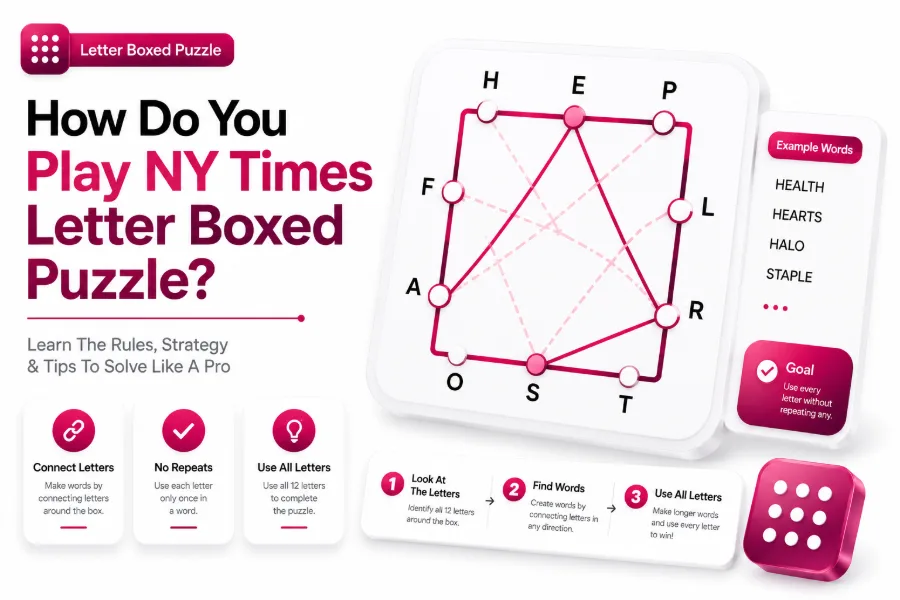
The NY Times Letter Boxed puzzle is a word game that looks simple but requires careful planning. Instead of filling a traditional crossword grid, you work with letters arranged around the four sides of a square. Your task is to connect those letters into words and eventually use every letter on the board.
If you are searching for how do you play ny times letter boxed puzzle, the basic idea is easy to learn. You create a word by selecting letters from different sides of the square. The last letter of one word becomes the first letter of your next word, creating a continuous chain. There is also an important restriction: you cannot select two consecutive letters from the same side.
The challenge comes from combining these rules while finding a solution that uses every letter efficiently. You may know many words, but that does not mean they will work on a particular board. Good Letter Boxed solving requires vocabulary, pattern recognition, and a little forward planning.
What the NY Times Letter Boxed Puzzle Is
Letter Boxed is a word puzzle from The New York Times Games collection. The board contains a set of letters arranged around the outside of a square, with several letters on each side. Players use those letters to create connected words instead of filling spaces like they would in a crossword.
The goal is to use every letter at least once. Letters can be reused, which means you do not need to cross each letter off permanently after using it. The real challenge is creating a chain where each word begins correctly and every consecutive letter follows the side restriction.
The Four Sides of the Board
The board has four groups of letters positioned on the top, right, bottom, and left sides. When spelling a word, you can choose letters from these groups, but you cannot select two consecutive letters from the same side.
This means the physical position of each letter matters. A word that looks perfectly valid when written normally may not be playable if two consecutive letters happen to sit on the same side of the square.
The Basic Rules of Letter Boxed
The rules are easier to follow once you separate them into two parts: the rules for building individual words and the rule connecting one word to another. Every letter you use must come from the board, and consecutive letters must come from different sides.
After you finish one word, its final letter determines the beginning of the next word. This creates a chain rather than a list of unrelated words. Your solution continues until all the letters on the board have been used.
Rule One: Use Letters From the Board
Every letter in your words must appear on the Letter Boxed board. You cannot introduce letters that are not shown. Since letters can be reused, the same letter may appear several times throughout your solution.
This makes the board more flexible than it might initially seem. You are not trying to use each letter exactly once. Instead, you are trying to make sure that every available letter appears somewhere in your connected sequence.
Rule Two: Switch Sides Between Letters
Consecutive letters cannot come from the same side of the square. If you select a letter from the top side, the next letter must come from the left, right, or bottom side.
This restriction applies while spelling a word. It is one of the main reasons Letter Boxed requires more planning than an ordinary word search. You need to consider both the spelling of a word and the physical location of each letter.
Rule Three: Connect Your Words
The final letter of one word becomes the first letter of the next word. For example, if your first word ends with T, the next word must begin with T.
A simple chain might look like:
WORD → DOG → GATE → EARN
The words shown here are only an example of the connection system. The actual words you can use depend entirely on the letters and their positions on your puzzle board.
Letter Boxed Rules at a Glance
- Use only letters displayed on the board.
- Consecutive letters must come from different sides.
- The next word begins with the previous word’s final letter.
- Letters may be reused.
- Use every letter on the board.
- Choose valid words accepted by the puzzle.
- Plan the chain instead of choosing words randomly.
How to Start a NY Times Letter Boxed Puzzle
When you open a new puzzle, resist the temptation to immediately type the first long word you notice. Start by scanning all four sides. Look for unusual letters, useful vowels, common combinations, and letters that may be difficult to include later.
A difficult letter can often determine your solution. If one letter appears to have very few possible combinations, find words containing it early in your planning. This can prevent you from reaching the end of the puzzle with one stubborn letter still unused.
Look for Difficult Letters First
Common vowels and consonants usually have many possible uses. Letters such as Q, X, Z, or other less flexible combinations can be harder to place, depending on the board.
When you spot a difficult letter, think of several words containing it. Then check whether those words can be formed without using two letters from the same side consecutively. This gives you a starting point for building a practical solution.
Do Not Always Choose the Longest Word
A long word can be useful because it may cover several letters at once. However, length does not automatically make a word a good choice.
Suppose a seven-letter word uses four letters you need but ends with an awkward letter. It could leave you with no useful continuation. A shorter word that covers two or three important letters and ends with a flexible letter may produce a much better overall solution.
How Word Chaining Works
Word chaining is the central strategy behind Letter Boxed. Every word affects the next one, so you should think about your solution as a sequence rather than separate answers.
When considering a possible word, look at its final letter immediately. Ask yourself whether you can think of another useful word beginning with that letter. If several options exist, the word is more likely to fit into a successful chain.
Planning the Next Move
Suppose you find a word that ends with R. Before committing to it, consider the words you could make beginning with R. If one of those words contains several unused letters, the original choice becomes more attractive.
This small habit can save a lot of time. Instead of asking only, “Can I make this word?” ask, “Where will this word take me?” That change in thinking is one of the easiest ways to improve at Letter Boxed.
Building a Chain With Coverage
Good solutions usually cover multiple unused letters as the chain progresses. If one word introduces several letters that have not appeared yet, it can reduce the amount of work needed later.
However, coverage should always be balanced with connectivity. A word that covers many letters is not helpful if its final letter creates a dead end. The strongest moves usually do both jobs at once.
A useful planning checklist:
- Scan all four sides before starting.
- Identify difficult letters.
- Find possible words containing those letters.
- Check the side of every consecutive letter.
- Consider each word’s final letter.
- Look for a useful next word.
- Track which letters remain unused.
- Review your chain before committing to it.
Strategies for Solving Letter Boxed Faster
Speed comes from recognizing useful patterns rather than simply typing words quickly. Experienced players tend to notice potential connections between letters almost immediately because they have seen similar combinations many times.
One effective approach is to search for words that perform multiple jobs. The best word may cover difficult letters, connect two parts of the board, and leave a useful final letter for the next move. Try to evaluate all three factors together.
Prioritize High-Value Words
A high-value word is not necessarily the longest word. It is a word that makes your overall solution easier. It might cover several unused letters or create a valuable connection between otherwise difficult groups.
For example, if a word uses an uncommon letter and ends in a common consonant, it may be more useful than a longer word that ends in an awkward letter. Think about the entire chain rather than the individual word.
Preserve Flexible Endings
Some letters give you many choices for the next word. Others can be surprisingly restrictive. When possible, preserve flexible endings until you have handled the more difficult parts of the board.
This does not mean you should avoid difficult final letters completely. Sometimes they are necessary. The key is to know what word can follow before you create that ending.
Use Common Word Patterns
Prefixes, suffixes, and familiar word roots can help when you run out of ideas. Patterns such as -ing, -ed, -er, -ly, and -tion may suggest possible words, provided the letters are positioned correctly on the board.
Do not rely on spelling patterns alone, though. Every candidate must still obey the side-switching rule. A familiar word is useless if its consecutive letters cannot be selected from different sides.
Practical solving tips:
- Start with difficult letters.
- Look for words that cover multiple unused letters.
- Check the ending before choosing a word.
- Keep at least one possible continuation in mind.
- Avoid unnecessary short words early in the chain.
- Reuse letters when it helps connect words.
- Check the board regularly instead of relying on memory.
- Try changing your opening word if the chain becomes difficult.
Common Letter Boxed Mistakes
Many new players make the same few mistakes. One is choosing a word simply because it is familiar. Another is forgetting that the next word must begin with the previous word’s final letter.
Players also sometimes focus so heavily on individual words that they forget to track unused letters. A solution can appear almost complete while leaving one difficult letter untouched. Checking the entire board throughout the process makes this less likely.
Choosing Words Without a Follow-Up
A word should not be judged only by whether it is valid. Consider where it leads. If you choose a word ending in a difficult letter without knowing what comes next, you may create a dead end.
Before selecting a word, pause for a moment and consider its final letter. If you can identify a useful continuation, the word becomes a stronger candidate. If not, keep searching.
Forgetting the Side Rule
This is one of the easiest mistakes to make because you naturally think about spelling rather than letter position. A word may look completely normal but fail because two consecutive letters are located on the same side.
Whenever you test a word, mentally follow each letter around the square. Check the side of the first letter, then the second, then the third. Once this becomes automatic, the rule becomes much easier to manage.
Leaving One Letter Until the End
It is frustrating to create a long chain only to find that one letter remains unused. This usually happens when the player does not consider difficult letters early enough.
Rather than waiting until the end, keep an eye on the letters you have not used. If one looks difficult, try to incorporate it into an earlier word. This gives you more options for building the rest of the chain.
How to Solve Letter Boxed When You Get Stuck
Getting stuck is normal, even when you know the rules. When your current chain stops working, do not immediately start guessing random words. First, identify exactly what is causing the problem.
Look at your current ending letter and the unused letters. Then search mentally for words that begin with your current letter and contain one or more of the unused letters. This narrows the possibilities considerably.
Work Backward From an Unused Letter
Working backward is one of the most useful techniques when you are stuck. Choose an unused letter and think of words that contain it. Then determine which starting letter those words require.
For example, if an unused letter appears in several words beginning with S, you can ask what word could end in S. That may reveal a connection that is difficult to spot when working only from the beginning of the chain.
Change an Earlier Word
Sometimes the problem is not your current word but a word several moves earlier. If your chain keeps producing poor endings, go back and replace an earlier choice.
Do not become attached to a word just because it covers several letters. Letter Boxed often requires experimentation. Changing one word can open several new possibilities and make the rest of the puzzle much easier.
When you are stuck, try this sequence:
- Identify your current starting letter.
- List the unused letters.
- Find words connecting those letters.
- Check the side position of each letter.
- Work backward if necessary.
- Replace an earlier word if your chain has become restrictive.
- Recheck every unused letter after making changes.
How to Improve Your Letter Boxed Skills
Regular practice is the most reliable way to become faster. You will gradually recognize common word structures and become better at spotting which letters can connect.
You do not need to memorize obscure vocabulary. Instead, pay attention to useful combinations and word endings that repeatedly appear in word puzzles. A growing awareness of these patterns can make difficult boards feel much more manageable.
Build a Mental List of Useful Patterns
Think about common beginnings and endings whenever you play. Words beginning with common letters can give you more continuation options, while certain endings can help connect to difficult parts of the board.
You can also remember useful words that frequently work as bridges. Over time, these become part of your natural word-game vocabulary, making it easier to generate candidates when you see a familiar letter arrangement.
Review Your Solutions
After solving a puzzle, take a moment to review the chain. Look at which word covered the most useful letters and which word created the strongest connection.
If you needed many words, see whether two of them could have been replaced with one. This kind of review helps you develop better planning skills instead of simply repeating the same solving habits.
Letter Boxed Compared With Other NYT Word Games
Letter Boxed has a different structure from many other word puzzles. Crossword puzzles generally give you clues and fixed answer spaces, while Wordle focuses on identifying one hidden word from repeated guesses.
Letter Boxed is more about constructing a connected sequence. You have a set of letters, but you must work within positional restrictions and maintain a chain between words. That makes it particularly rewarding for players who enjoy vocabulary combined with strategy.
Letter Boxed and Wordle
Wordle asks you to identify a five-letter word through a limited number of guesses. Letter Boxed does not provide the same type of feedback after each guess.
Instead, Letter Boxed gives you a fixed collection of letters and asks you to use all of them through connected words. The two games both require vocabulary, but their solving methods are quite different.
Letter Boxed and Crossword Puzzles
Crosswords rely heavily on clues, intersections, and general knowledge. Letter Boxed does not use conventional clues to tell you what words to find.
The challenge comes from the relationships between letters. You must think about word formation, side positions, and word endings. Players who enjoy strategic word construction may find Letter Boxed especially engaging.
| Feature | Letter Boxed | Wordle | Crossword |
|---|---|---|---|
| Main objective | Use all board letters | Find the hidden word | Complete the grid |
| Clues | Letter arrangement | Guess feedback | Written clues |
| Word chain | Yes | No | No |
| Side restriction | Yes | No | No |
| Vocabulary | Important | Important | Very important |
| Planning | High | Moderate | High |
Useful Resources for Letter Boxed Players
If you play several word games, additional puzzle resources can help you build vocabulary and develop better solving habits. A [Letter Boxed strategy guide](Internal Link: Letter Boxed Strategy Guide) can provide more solving ideas, while a [NYT Spelling Bee guide](Internal Link: NYT Spelling Bee Guide) can help if you enjoy other word-based games.
However, outside resources should support practice rather than replace it. Trying to solve the board yourself first gives you a much better feel for how the letter relationships work. Even an unsuccessful attempt can teach you something about the puzzle’s structure.
How to Practice Letter Boxed Effectively
Start by giving yourself enough time to think before checking a solution. Your first goal should be finding a complete chain, not beating a particular time or word count.
Once you can regularly complete puzzles, begin looking for shorter solutions. Compare different chains and identify which words provide the most useful coverage. This gradually shifts your approach from simply solving the puzzle to solving it efficiently.
Focus on Accuracy Before Speed
Trying to solve too quickly can lead to careless mistakes. You may overlook a side restriction or choose a word that creates a difficult ending.
Take your time at first. Once the rules become automatic, your speed will improve naturally. Fast solving is usually the result of familiarity rather than rushing.
Challenge Yourself With Different Approaches
If you normally start with a long word, try starting with a difficult letter instead. If you normally work forward, try working backward from an unused letter when you get stuck.
Changing your approach helps you recognize that there is rarely only one useful path through a puzzle. Flexibility is one of the most important skills for consistently solving challenging boards.
Final Thoughts
The NY Times Letter Boxed puzzle rewards players who combine vocabulary with careful planning. The basic rules are simple: use the letters around the four sides, avoid consecutive selections from the same side, connect each new word to the final letter of the previous word, and use every letter on the board.
The real challenge is deciding which words will work together. A word can be perfectly valid but still be a poor choice if it creates an awkward ending or leaves difficult letters behind. Strong solving comes from thinking several moves ahead, watching unused letters, and being willing to change your approach when a chain stops working.
For anyone searching how do you play ny times letter boxed puzzle, the best place to start is with the basic rules. Once those become familiar, focus on difficult letters, useful word endings, and connected chains. With regular practice, you will begin seeing possible solutions faster and making better choices from the start.
FAQ
What is the goal of NYT Letter Boxed?
The goal is to use every letter shown around the four sides of the square. You create connected words, with each new word beginning with the final letter of the previous word, while following the side-switching rule.
Can you reuse letters in Letter Boxed?
Yes, letters can be reused throughout the puzzle. You only need to make sure that every letter on the board is used at least once. Reusing letters can help create connections between different words.
Can two letters come from the same side?
No. Consecutive letters cannot come from the same side of the square. You must switch to another side before selecting the next letter, even when the resulting word would otherwise be valid.
How do you get better at Letter Boxed?
Practice identifying difficult letters, useful word endings, and potential word chains. Before selecting a word, consider its final letter and whether it gives you a useful starting point for the next word.
Is Letter Boxed harder than Wordle?
They require different skills. Wordle focuses on identifying one hidden word through guesses, while Letter Boxed requires you to build a connected chain and use every board letter. Letter Boxed generally involves more multi-step planning.
0 Comments