
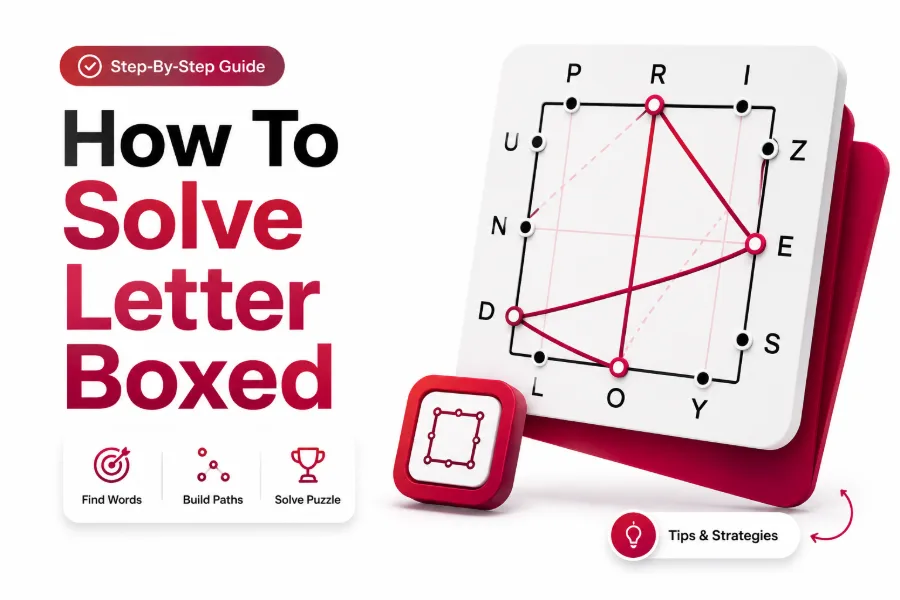
Letter Boxed looks simple at first glance, but finding the right words can become surprisingly difficult when the available letters seem to lead nowhere. The puzzle gives you a square with letters arranged around four sides, and your goal is to connect them into words while using every letter. The challenge comes from choosing words that work together rather than solving each word separately.
If you are learning how to solve letter boxed, the biggest improvement comes from changing your approach. Instead of searching randomly for long words, look for useful letter combinations, identify difficult letters, and think several moves ahead. A good solution often depends on one carefully chosen word that connects two otherwise unrelated parts of the puzzle. With a repeatable strategy, you can reduce guesswork and solve puzzles more consistently.
How Letter Boxed Works
Letter Boxed is a word puzzle built around twelve letters placed on the four sides of a square. You create words by selecting letters from the available sides, but two consecutive letters cannot come from the same side. Every word must therefore move between different sides as you build it.
The goal is to use all twelve letters while creating as few words as possible. The last letter of one word becomes the first letter of the next word, which makes word selection especially important. A strong opening word can create several useful options, while a poor choice may leave difficult letters stranded.
The Basic Rules To Remember
Before searching for words, keep the core rules in mind. Letters on the same side cannot be used consecutively, so a word containing two neighboring letters from one side will not work. The puzzle also requires every letter to appear somewhere in your final chain.
The connection between words is equally important. If one word ends with R, the next word must begin with R. This means you should not judge a word only by whether it is valid. You also need to consider what its final letter gives you as the starting point for the next word.
Key Rules
- Consecutive letters must come from different sides.
- You must use every letter in the puzzle.
- The first letter of a new word should match the final letter of the previous word.
- Words should work together as a chain.
- Shorter solutions are generally more desirable.
- Reusing letters is allowed when the side-to-side rule is followed.
Start With The Difficult Letters
One of the most useful techniques is to identify the letters that are hardest to use. Some letters naturally appear in many English words, while others have far fewer possibilities. Beginning with common letters can feel productive, but it may leave an awkward letter for the end.
Look for letters such as Q, X, Z, J, V, or uncommon consonant combinations when they appear. These letters can determine the structure of your solution. If one difficult letter can only connect to a small number of useful words, finding that connection early can eliminate many dead ends.
Find Useful Word Endings
Word endings can be more valuable than word beginnings. Common endings such as -ING, -ED, -ER, -LY, -TION, and -NESS can provide several possible routes through the puzzle. However, the letters still need to follow the side rule, so familiar endings should be treated as possibilities rather than automatic answers.
Pay particular attention to the final letter of a candidate word. A word ending in a highly useful letter can open several new paths. Conversely, a word that ends with a difficult starting letter may force you into an awkward second move. Always evaluate the word and its next move together.
A Simple Starting Checklist
- Identify all twelve letters.
- Group the letters by their four sides.
- Mark unusual or difficult letters.
- Look for common prefixes and endings.
- Find words that connect different sides naturally.
- Check the final letter of every candidate word.
- Avoid committing to the first long word you find.
Build A Letter Connection Map
A mental connection map can make the puzzle much easier. Think of each letter as a point that can connect to letters on the other three sides. Letters on the same side cannot connect directly, while letters on different sides can potentially appear next to each other.
You do not need to draw a complicated diagram. Simply notice which letters have many possible neighbors and which ones have very few. A letter with several connections gives you flexibility, while a restricted letter can become a bottleneck. Solving around bottlenecks is often more efficient than building from the most obvious word.
Look For Bridge Words
A bridge word is especially valuable because it connects letters that otherwise appear difficult to combine. For example, suppose your first word covers several letters but finishes with a letter that can begin a second word containing an unused group. That second word acts as a bridge toward the remaining letters.
When searching for a bridge, do not focus only on word length. A seven-letter word that connects two useful groups may be better than a ten-letter word that leaves an awkward collection behind. The purpose of each word is to move your solution closer to covering all twelve letters.
What Makes A Strong Bridge Word
- It begins with the final letter of the previous word.
- It introduces several unused letters.
- It follows the side-to-side rule throughout.
- It ends with a useful letter.
- It avoids creating an isolated final letter.
- It helps reduce the number of remaining possibilities.
Avoid Starting With The Longest Word
Long words are tempting because they can cover many letters at once. However, coverage alone does not guarantee progress. A long word may consume letters that would have been useful for connecting other parts of the puzzle, leaving you with a difficult final group.
Instead, consider the value of a word based on what it makes possible afterward. A shorter word can sometimes be much stronger if its ending gives you access to several unused letters. The best first move is usually flexible rather than simply long.
Use Word Families To Generate Options
When you find one promising word, think about related words. A base word may suggest several alternatives with different endings or starting letters. These variations can help you adjust the chain when the first version creates a dead end.
For example, if you find a useful pattern ending in -ER, consider whether another form of the word can end differently while still covering important letters. Plurals, related forms, and common grammatical variations may provide a route that the original word does not.
Useful Word Patterns
Common patterns worth testing include:
- -ING
- -ED
- -ER
- -LY
- -TION
- -MENT
- -NESS
- -ABLE
- -FUL
- -LESS
These patterns are not guaranteed solutions. Always check the side restriction and the letters already used before accepting one.
Work Backward From A Difficult Letter
When you get stuck, stop trying to continue from the beginning. Instead, choose one unused letter and ask which words could contain it. This backward approach can reveal a word that would be difficult to notice through normal forward searching.
Suppose one unused letter can only appear naturally after a few specific letters. Those possible preceding letters give you a smaller search area. Once you find a suitable word, work backward again from its starting letter to connect it to your existing chain.
Track Used And Unused Letters
Mental tracking becomes difficult once several words are involved. A simple written list can prevent repeated mistakes. Separate the twelve letters into two groups: letters already covered and letters still missing.
After every candidate word, update the list. This immediately shows whether the word made meaningful progress. If a word mostly repeats letters you already used, it may be legal but strategically weak. A strong move usually adds at least one important unused letter while maintaining a useful connection.
Practical Tracking Method
| Stage | What To Record |
|---|---|
| Start | All twelve letters |
| First word | Letters covered and final letter |
| Second word | Newly covered letters |
| Middle | Remaining difficult letters |
| Final stage | Letters still unused |
| Finish | Confirmation that every letter appears |
Think About The Final Move Early
A common mistake is to solve most of the puzzle and only then consider the final word. This can create a frustrating situation where one unused letter cannot fit into the existing chain. Thinking about the ending early can prevent that problem.
When you identify a difficult letter, consider not only how to use it but also where it might appear near the end. If a particular word can cover the final letters and begins with a likely previous ending, you have a potential finishing route. Keep that possibility in mind while building the earlier chain.
Use The Fewest Words Possible
Letter Boxed rewards efficient solutions, but the shortest possible chain is not always obvious. A two-word solution requires the first word to end with the starting letter of the second word while the two words collectively cover every letter.
Three-word solutions are often easier because they provide more opportunities to redirect the chain. If a two-word attempt leaves you repeatedly stuck, try three connected words rather than forcing an unnatural combination. Efficiency matters, but a practical solution is more useful than endless searching for perfection.
Common Mistakes That Make Letter Boxed Harder
Many failed attempts come from strategy rather than vocabulary. Players often find a valid word and immediately commit to it without checking what happens next. Another frequent problem is concentrating on familiar words while ignoring unusual but valid combinations.
It is also easy to overlook the importance of the final letter. A word can cover several missing letters and still be a poor choice if its ending cannot lead to another useful word. Every move should be evaluated for both its immediate coverage and its future potential.
Mistakes To Avoid
- Starting with a random long word.
- Ignoring difficult letters until the end.
- Forgetting that consecutive letters cannot share a side.
- Choosing words without checking their final letters.
- Repeating already-used letters without gaining coverage.
- Trying to force a two-word answer immediately.
- Refusing to replace a promising word when the chain stops working.
A Step-By-Step Method For Solving
A repeatable process is more useful than memorizing individual words. Begin by mapping the letters and identifying difficult combinations. Then search for words that cover those problem areas while producing useful endings.
Once you have a few candidates, build a chain and track every unused letter. If the chain reaches a dead end, return to the previous decision instead of starting over completely. Replace the weakest word and test another connection. This makes the solving process faster and more systematic.
The Seven-Step Process
- Map the four sides
Separate the twelve letters into their correct groups. - Find restricted letters
Identify letters with fewer obvious word combinations. - Search for bridge words
Prioritize words that connect difficult groups. - Check every transition
Make sure consecutive letters come from different sides. - Track coverage
Record which letters have already been used. - Plan the ending
Keep potential final words in mind before committing to the middle. - Replace weak moves
If the chain fails, change the word that creates the bottleneck.
How To Improve Your Letter Boxed Speed
Speed improves when you stop searching every possible word. Instead, train yourself to recognize common letter patterns and side relationships. After solving several puzzles, you will begin to notice useful endings, difficult consonants, and common transition points more quickly.
Vocabulary also matters, but you do not need to memorize a dictionary. Reading regularly and paying attention to unusual words can gradually expand the pool of possibilities available during a puzzle. The goal is to combine vocabulary knowledge with positional reasoning rather than relying on either one alone.
Speed Tips
- Scan the puzzle before forming any word.
- Identify the hardest letter first.
- Look for words that cover multiple unused letters.
- Check the final letter before accepting a word.
- Keep a possible ending in mind.
- Use three-word solutions when two-word attempts become restrictive.
- Restart from the weakest decision rather than from scratch.
When You Get Completely Stuck
Getting stuck does not necessarily mean you lack vocabulary. Sometimes the current chain is simply wrong. If every available next word creates another problem, go back one move and test a different ending.
Another useful technique is to focus on the letters you have not used. Ignore the completed portion of the puzzle temporarily and search for a word that covers two or three of the remaining letters. Then determine which previous ending could connect to that word. This reduces the search space considerably.
For additional word-puzzle strategies, you can also use [Internal Link: Letter Puzzle Strategies] as a related resource when building your solving routine.
How To Recognize A Nearly Complete Solution
A solution is usually close when only a small group of letters remains and those letters appear in a recognizable word pattern. At this stage, avoid changing everything. Examine the final few letters and determine which word could cover them.
If one letter remains isolated, check the word immediately before it. The problem may not be the final word at all. Changing the previous word’s ending can create the exact starting point needed to absorb the remaining letter. Small adjustments often solve a puzzle that initially appears impossible.
Using Online Help Without Losing The Skill
Word-solving tools can be useful when you want to verify a difficult puzzle, but they should not replace the reasoning process entirely. Try solving the puzzle independently first, then use assistance to identify where your approach went wrong.
If a tool provides a solution, study the connection between its words. Look at which letter allowed the transition and why the words cover the remaining letters efficiently. This turns an answer into a learning opportunity instead of simply revealing the result.
Advanced Strategy For Difficult Puzzles
Harder puzzles often require you to think in terms of transitions rather than individual words. Instead of asking which word uses a particular letter, ask which letter you need to end on so that the next word becomes possible.
This creates a chain of dependencies. Word A determines the ending letter, which determines Word B, and Word B determines the next available starting point. When several letters are restrictive, planning these transitions in advance can dramatically reduce the number of possible combinations.
Transition Planning
Imagine that three unused letters can only be included efficiently by words beginning with M. Your current word should therefore ideally finish with M. That makes the final letter of your current word more important than the number of letters it covers.
This way of thinking turns the puzzle into a small network of choices. You are not merely finding words; you are selecting words that create the right starting points for the next move.
A Practical Example Of The Strategy
Suppose your current chain has covered most of the letters, but three difficult letters remain. You find a word that uses two of them, but it starts with T. Your current word ends with R, so the candidate cannot be used immediately.
Rather than discarding it, look for a word beginning with R that ends in T. If that word can also cover another unused letter, it creates a bridge between your current chain and the difficult word. This illustrates why working backward can be just as useful as searching forward.
The Best Mindset For Consistent Solving
The strongest solvers do not expect every first attempt to work. They test possibilities, notice where a chain fails, and adjust the specific decision causing the problem. This keeps the puzzle manageable instead of turning it into a frustrating search through thousands of words.
Treat each failed chain as information. If a word leaves an impossible ending, you have learned which type of transition to avoid. Over time, these small observations build a reliable solving instinct. Vocabulary helps, but good decision-making is what turns that vocabulary into successful solutions.
Quick Reference
- Map first: Know which side contains each letter.
- Prioritize restrictions: Difficult letters deserve early attention.
- Think in chains: Every word should prepare the next one.
- Watch endings: The final letter controls your next option.
- Track coverage: Do not forget unused letters.
- Use bridge words: Connect difficult groups through useful transitions.
- Work backward: Start from an awkward letter when forward searching fails.
- Stay flexible: Replace weak words instead of forcing them.
- Plan the finish: Keep the last move in mind throughout the solve.
- Practice patterns: Common prefixes and endings become easier to spot.
Conclusion
Solving Letter Boxed becomes much easier when you stop treating each word as an isolated answer. The puzzle is really about building a connected chain while respecting the side restriction and making sure every letter is eventually used. The strongest approach combines vocabulary, pattern recognition, letter tracking, and forward and backward planning.
Start by identifying difficult letters, then search for bridge words that connect useful groups. Pay close attention to each word’s final letter because it determines where the chain can go next. If an approach fails, replace the move creating the bottleneck instead of abandoning the entire solution.
The key to how to solve letter boxed is consistency. Map the puzzle, prioritize restricted letters, test useful connections, and keep the ending in mind. With regular practice, you will recognize patterns faster, make fewer dead-end choices, and approach difficult puzzles with a much clearer strategy.
FAQ
How many words should a Letter Boxed solution use?
A solution can sometimes be completed in two words, but three or more words may be easier. The best approach is to prioritize a valid, efficient chain that uses every letter rather than forcing a specific word count.
Can letters from the same side be used together?
No. Consecutive letters cannot come from the same side of the Letter Boxed square. Each next letter must be selected from one of the other three sides, which is the main restriction when forming words.
What should I do with difficult letters?
Identify difficult letters early instead of saving them for the end. Look for words that include them naturally, then check whether those words produce useful starting or ending letters for the rest of your chain.
Is a longer word always better?
Not necessarily. A long word may cover many letters but leave an unusable ending. A shorter word can be strategically stronger when it connects several difficult letters or creates a useful transition into another word.
How can I get better at Letter Boxed?
Practice recognizing common word patterns, tracking unused letters, and evaluating word endings. When you get stuck, work backward from a difficult remaining letter and look for a word that could connect it to your existing chain.
0 Comments