
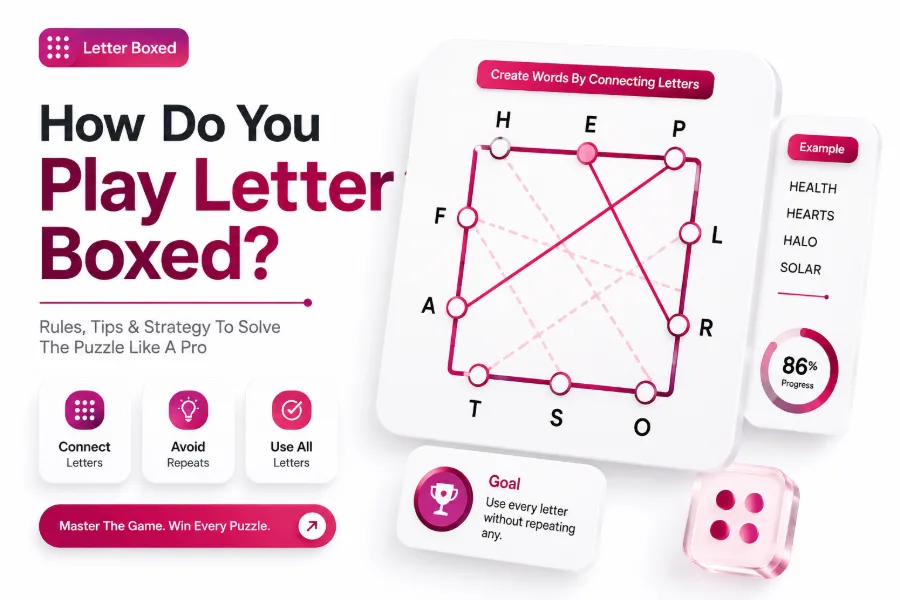
Letter Boxed is a word puzzle that looks simple at first but quickly becomes a test of vocabulary, pattern recognition, and planning. The puzzle gives you a square divided into four sides, with several letters placed around the outside. Your goal is to connect those letters into words and use all of the available letters while following a few important rules.
If you are wondering how do you play letter boxed, the main idea is to create words by choosing letters from different sides of the square. The last letter of one word becomes the first letter of the next word, so each choice affects what you can play afterward. You also cannot choose two letters from the same side consecutively.
Once you understand these rules, the puzzle becomes much easier to approach. Instead of guessing random words, you can look for useful letter combinations, identify difficult letters, and build a chain that covers the entire board.
What Letter Boxed Is
Letter Boxed is a word game associated with The New York Times Games collection. It uses a square board containing letters along its four sides. Players create words from those letters, with each new word beginning with the final letter of the previous word.
The objective is to use every letter on the board while using as few words as possible. The puzzle rewards players who think several moves ahead rather than simply finding the longest words they know. A short word can sometimes be more valuable than a long one if it creates the right starting letter.
The Four-Sided Board
The letters are arranged on four sides of a square rather than in a conventional grid. When selecting consecutive letters, you must move between different sides. This restriction is one of the most important parts of the puzzle.
For example, if you select a letter from the top side, the next letter cannot also come from the top side. You can instead select a letter from the left, right, or bottom side, provided it forms a valid word.
The Basic Rules of Letter Boxed
The rules become straightforward once you see how the word chain works. You create a word using letters from the square, and the final letter of that word determines where your next word must begin. This creates a connected sequence rather than a collection of unrelated answers.
You can use letters more than once during the puzzle, but consecutive letters cannot come from the same side. Your words must also follow the game’s accepted vocabulary. Proper nouns, abbreviations, and some unusual word forms may not be accepted.
The Word Chain Rule
Suppose your first word ends with the letter T. Your next word must begin with T. If that second word ends with R, the following word must begin with R.
This creates a chain such as:
WORD → DOG → GATE → EARN
The exact words will depend on the letters available on the board. The important point is that the final letter always controls the beginning of your next word.
The Side-Switching Rule
You cannot select two consecutive letters from the same side of the square. This rule applies while spelling each word.
If two letters are next to each other on the same side, you cannot use them consecutively. You must choose the next letter from one of the other three sides.
Key rules to remember:
- Use letters shown on the four sides.
- Do not select consecutive letters from the same side.
- The last letter of one word starts the next word.
- Use every letter on the board.
- Create words accepted by the puzzle.
- Try to complete the board with as few words as practical.
How to Start a Letter Boxed Puzzle
The best way to begin is not to immediately search for a long word. First, scan the entire board and identify letters that may be difficult to use. Rare letters or letters with limited word combinations can determine the direction of your solution.
Look at each side separately, then consider possible combinations between sides. Pay particular attention to common endings such as -ING, -ED, -ER, and -TION, while remembering that every consecutive pair must obey the side-switching rule.
Find Difficult Letters First
Some letters are much easier to incorporate into words than others. Common vowels and frequently used consonants often appear naturally in many words. Less common letters may require more deliberate planning.
If one letter seems difficult to use, try finding words that contain it and also end with a useful letter. A good word should ideally solve more than one problem by covering an unused letter while giving you a productive starting point for the next word.
Look for Useful Endings
Word endings can provide strong clues. If the board allows combinations that form common endings, consider whether they can help connect several parts of your solution.
However, do not choose a word simply because it is long. A seven-letter word may cover several letters but leave you with an awkward final letter. A shorter word that creates a useful chain can be the better move.
Quick starting checklist:
- Scan all four sides.
- Mark unusual or difficult letters mentally.
- Look for common letter combinations.
- Identify possible word endings.
- Consider the final letter of every candidate word.
- Avoid committing to the first possible word.
How to Build a Letter Boxed Solution
A successful solution usually requires planning several words together. Think of each word as a link between letters rather than as an independent answer. The final letter of one word should ideally lead to a useful word containing letters you still need.
For example, imagine you find a word that covers three unused letters but ends in a letter that has very few possible continuations. That word might not be useful. Another word covering only two new letters could be much better if its final letter opens several possibilities.
Work Backward From Difficult Letters
Working backward can be especially effective when you are stuck. Pick a letter that has not yet been used and think of words containing it. Then examine which of those words could begin from the final letter of a previous word.
This approach reduces random guessing. Instead of searching the entire vocabulary, you are solving a smaller problem: find a word that contains a specific unused letter and connects naturally to the current chain.
Think in Chains Rather Than Individual Words
A common mistake is trying to solve the puzzle one word at a time without considering what comes next. Letter Boxed rewards forward planning because every word determines your next starting point.
When you find a possible word, immediately check its final letter. Ask yourself whether several useful words can begin with that letter. If the answer is no, keep looking for another option.
Strategies That Make Letter Boxed Easier
The strongest strategy is to treat the board as a network of possible connections. Each letter can lead to several others, but the side restriction removes many possibilities. Thinking about these connections makes the puzzle more manageable.
Another useful habit is to avoid using a letter simply because it is available. The goal is not to use letters as quickly as possible. The goal is to create a chain that eventually covers every letter while keeping future moves open.
Prioritize Coverage
When comparing two possible words, consider how many unused letters each one covers. A word that introduces several new letters can be valuable, particularly when its final letter provides good follow-up options.
Coverage alone is not enough, though. A word that covers many letters but creates a dead end may force you into extra words later.
Preserve Flexible Letters
Some ending letters provide many possible continuations. Common consonants and vowels can often give you numerous options. If possible, avoid creating a chain that ends on a difficult letter before you have a clear continuation.
Think of flexible letters as bridges. They allow you to move between different groups of letters and can help connect otherwise separate parts of the board.
Useful solving tips:
- Start with difficult letters.
- Look for words that cover multiple unused letters.
- Check the final letter before committing to a word.
- Keep several possible next words in mind.
- Avoid dead-end endings.
- Remember the side restriction while testing words.
- Reuse letters when it helps your chain.
- Try to reduce the number of words after finding a complete solution.
Common Mistakes New Players Make
Many beginners assume that the longest word is automatically the best answer. It is not. Letter Boxed is about connections, so the usefulness of a word depends heavily on its starting and ending letters and the other letters it covers.
Another common mistake is forgetting that consecutive letters cannot come from the same side. You may see a perfectly familiar word in the letters and assume it works, only to find that two adjacent selections violate the board’s side rule.
Choosing Words Without Planning Ahead
A word can look excellent because it uses several letters you need. But if it leaves you with an inconvenient starting letter, your next move may become difficult.
Before entering a word, consider its final letter. Try to identify at least one realistic continuation. This small habit can prevent many dead ends.
Ignoring Unused Letters
It is easy to focus on familiar words and forget one or two letters sitting on the board. When you think you have solved the puzzle, check every letter individually.
A complete solution must account for the entire set of letters. If one letter remains unused, you need to adjust the chain rather than simply adding a random word at the end.
Improving Your Letter Boxed Solving Skills
Getting better at Letter Boxed mainly comes from recognizing patterns faster. You do not need an enormous vocabulary to improve. Familiarity with prefixes, suffixes, common word roots, and unusual letter combinations can make a significant difference.
It also helps to pay attention to how words connect. Over time, you begin to recognize that certain ending letters are particularly useful and that some words can act as bridges between otherwise difficult groups of letters.
Build a Useful Word Vocabulary
You do not need to memorize hundreds of obscure words. Instead, become comfortable with common word structures and less obvious combinations that frequently appear in word games.
Pay attention to prefixes such as un-, re-, and pre-, as well as common endings such as -ing, -er, -ed, and -ly. These patterns can help you generate possibilities when the board looks unfamiliar.
Practice Without Looking for the Answer
If you regularly play word puzzles, give yourself time to solve the board before checking a solution. Even failed attempts are useful because they show which letters and endings create problems.
After finishing, review the successful chain. Ask why each word was useful and whether there was a shorter route. This turns each puzzle into practice for future boards.
How to Solve Letter Boxed When You Are Stuck
When you cannot find the next word, stop trying random combinations. Return to the board and identify which letters remain unused. Then look for words containing those letters while starting with the required letter from your current chain.
You can also temporarily work backward. Choose an unused letter and find potential words containing it. Then determine what preceding letter would allow that word to enter your chain. This often reveals a connection you missed.
Reset Your Thinking
If you have tried several combinations without progress, your current first word may be the problem. Do not be afraid to abandon it and start from a different letter.
A strong solution may require changing an early word even when that word appears perfectly valid. Letter Boxed is not simply about finding valid words; it is about finding words that cooperate with one another.
Use the Board as a Map
Imagine each side as a separate group of letters. Your selections must move between groups, so the board can be viewed as a map of possible transitions.
This perspective helps you notice combinations that might not stand out when you simply read the letters individually. It also makes the side restriction easier to remember.
Letter Boxed Compared With Other Word Puzzles
Letter Boxed differs from many familiar word games because the objective is not simply to find words. The words must connect through their first and last letters, while individual letter selections must also follow the side-switching rule.
That combination gives the puzzle a strategic element. Vocabulary helps, but planning is equally important. A player who recognizes connections can sometimes outperform someone with a much larger vocabulary.
What Makes It Different
Unlike a standard crossword, you are not filling predetermined spaces. Unlike a typical word search, you are not simply locating hidden words. Instead, you are constructing a chain that gradually accounts for the entire board.
The puzzle also encourages experimentation. A word that does not help in one position may become useful after you change the preceding word.
| Puzzle feature | Letter Boxed |
|---|---|
| Main goal | Use all board letters |
| Board shape | Four-sided square |
| Word connection | Last letter starts the next word |
| Consecutive side rule | Required |
| Strategy | Planning and word chaining |
| Vocabulary | Important |
| Pattern recognition | Very important |
How to Practice and Get Faster
The easiest way to improve is to play regularly and analyze your decisions. Speed usually comes naturally after you become familiar with the game’s structure. Focus on accuracy first rather than trying to finish immediately.
Try setting a personal goal for each puzzle. For example, you might first aim to find any complete solution. Once you can do that consistently, try reducing the number of words or finding a cleaner chain.
Track Your Problem Letters
If certain letters repeatedly cause trouble, make a mental note of them. You may notice that the same types of combinations slow you down across different puzzles.
You can also build a personal collection of useful word patterns. Over time, these patterns become easier to recall, reducing the amount of time you spend searching for possibilities.
Focus on Efficient Solutions
Once you find a complete chain, do not automatically stop. Look at whether two words can be replaced by one or whether changing the order produces a shorter solution.
Efficiency is a useful secondary goal because it encourages better planning. However, completing the board correctly should always come before trying to minimize the number of words.
Helpful Resources for Word Puzzle Players
If you regularly play word games, keeping a few useful resources nearby can make practice more enjoyable. A [Letter Boxed puzzle guide](Internal Link: Letter Boxed Puzzle Guide) can provide additional strategies, while a [NYT Spelling Bee answers guide](Internal Link: NYT Spelling Bee Answers) can help if you also play other New York Times word games.
The most useful resource, however, is the puzzle itself. Regular practice exposes you to different letter arrangements and teaches you to recognize useful connections without relying on outside help.
Final Thoughts on Playing Letter Boxed
Letter Boxed becomes much less intimidating once you stop treating it as a simple word-finding game. The real challenge is building a connected chain while respecting the four-sided board. Every word has a purpose, and the final letter of one word determines where your thinking needs to go next.
If you are still learning how do you play letter boxed, start by mastering the basic rules before worrying about speed or word count. Look for difficult letters, consider the ending of each word, and keep future moves in mind. With regular practice, you will begin spotting useful chains much faster. The best solutions usually come from a combination of vocabulary, patience, and planning rather than from guessing the longest word possible.
FAQ
What is the main goal of Letter Boxed?
The goal is to use every letter on the four-sided board while creating a connected chain of valid words. Each new word starts with the final letter of the previous word, and consecutive letters cannot come from the same side.
Can letters be reused in Letter Boxed?
Yes. Letters can be used more than once when forming words. However, consecutive letters must still come from different sides of the square. Reusing a letter can often help connect separate parts of the puzzle.
How many words should you use?
There is no need to use the maximum number of words. A complete solution is the first priority, while using fewer words can provide a more efficient solution. The best approach depends on the particular board.
Why does a word not work in Letter Boxed?
A word may fail because its letters violate the side-switching rule or because it is not included in the puzzle’s accepted vocabulary. Check the letter positions and make sure every consecutive pair comes from different sides.
What is the best way to get better at Letter Boxed?
Practice regularly and focus on connections rather than isolated words. Look for difficult letters, examine possible endings, and plan at least one move ahead. Reviewing failed attempts can also reveal useful patterns for future puzzles
0 Comments